Stability and Balance: The Foundation of Longevity for the Active Adult Over 40
For the active adult over 40, the fitness landscape shifts. In your 20s and 30s, you might have trained for peak performance, maximum aesthetics, or simply to "sweat." But as you cross the 40-year threshold, the objective must evolve. You are no longer just training for next month’s beach trip; you are training for your 80-year-old self.
At Creative Fitness NYC LLC, we view fitness through the lens of longevity and durability. The most impressive physique is useless if the underlying framework: your stability and balance: is crumbling. If you cannot stabilize your joints or maintain center of mass over your base of support, you are not truly fit; you are just a collection of strong muscles waiting for an injury to happen. For clients over 40, the priority is not novelty. It is resilience. It is building a body that handles real life, absorbs force well, and stays durable under stress.
The 20-Year Horizon: Moving Well for the Long Game
When we talk about longevity, we aren't just talking about living longer; we are talking about healthspan: the period of life spent in good health, free from chronic disease and functional disability.
Think about where you want to be 20, 30, or 40 years from today. Do you want to be the person who can still hike, travel, and lift their own luggage? Or do you want to be the person sidelined by a "bad back" or a fear of falling? Stability is the insurance policy for your future independence. Research shows that balance begins to decline in our 40s, often imperceptibly, as our sedentary habits increase and our sensory systems (vision, vestibular, and proprioception) are less frequently challenged.
By prioritizing stability now, you are building the physical "brakes" and "suspension" that will keep you moving fluidly well into your 80s.
Stability vs. Strength: Understanding the Foundation
It is a common misconception that strength and stability are the same thing. They are related, but distinct:
- Strength: The ability of a muscle or group of muscles to produce force against resistance.
- Stability: The ability of your body to maintain control of a joint or posture during movement or while resisting external forces.
You can have massive quads (strength) but still have "leaky" knees that collapse inward during a squat (lack of stability). For the active adult, stability is the foundation upon which strength is built. Without stability, your nervous system will actually "throttle" your strength output as a protective mechanism. It won't let you push 100% power if it doesn't trust your joints to hold the load.

Training for Durability vs. Training for the Mirror
Most big-box gym routines are designed for "the mirror." They focus on isolated muscle groups: bicep curls, leg extensions, chest presses: designed to make muscles pop. While there is nothing wrong with looking good, mirror-focused training often ignores the deep stabilizers and the kinetic chain integration required for real-world movement.
Training for durability is different. It’s about "no-fluff" functional integrity. It involves:
- Multi-planar movement: Moving sideways and rotationally, not just forward and back.
- Unilateral work: Training one limb at a time to eliminate compensations.
- Proprioceptive challenge: Forcing the brain and muscles to communicate faster to stay upright.
When you prioritize durability, the "mirror results" happen as a byproduct. However, the reverse is rarely true. A body built only for aesthetics is often fragile and prone to overuse injuries.
The Single-Leg Balance and Reach: Your Diagnostic Baseline
At Creative Fitness NYC LLC, we don’t guess; we assess. The Single-Leg Balance and Reach remains one of the best ways to identify leaks in the kinetic chain. It shows how well your foot, ankle, hip, and trunk organize under load. Once that baseline is established, we can layer in more demanding progressions that challenge durability without fluff.
How to Perform the Diagnostic
- Set Up: Stand on one leg with a soft bend in the standing knee. Drive the non-standing leg into full hip extension behind you without arching the low back.
- The Reach: Reach with the opposite arm in three planes: front (sagittal), on the same side (frontal), and reaching across your body (transverse). Lightly touch each target without dumping weight into it.
- The Return: Bring the ball of the non-standing foot back to the floor as a light touch-point. Regain posture. Repeat without rushing.
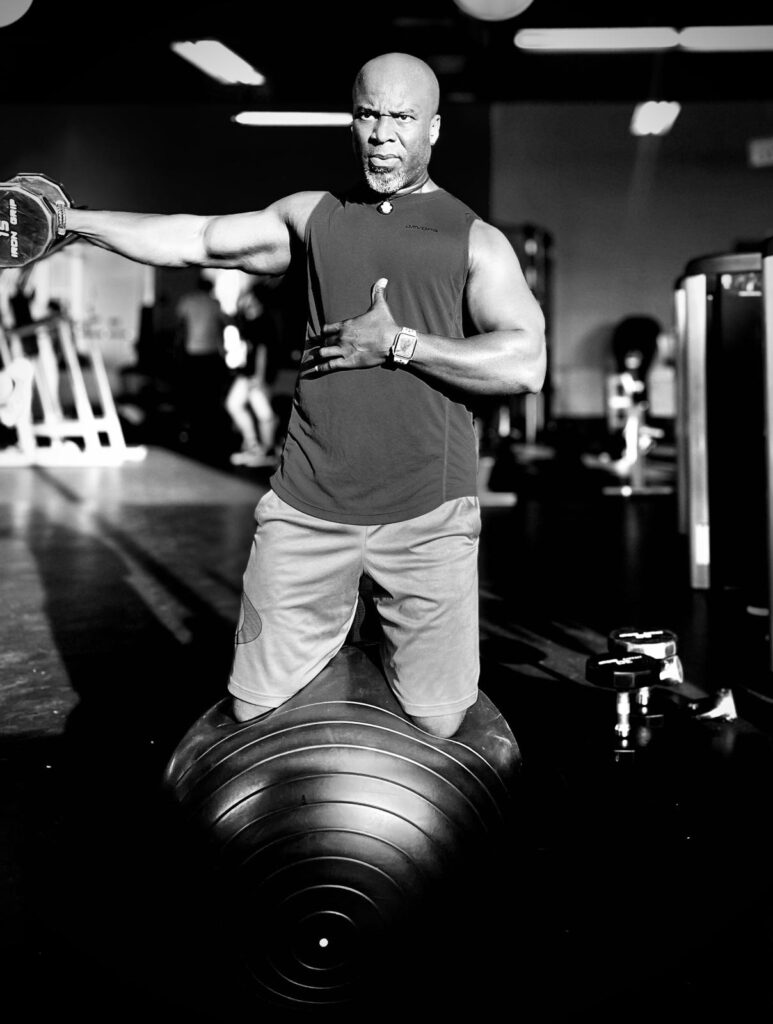
From there, the next progression is the Stability Ball Kneeling Single-Arm Raise. This drill strips away lower-body compensation and forces the trunk and shoulder to do the work. You are no longer relying on the floor to save you. The unstable base exposes whether you can organize the hips, rib cage, and shoulder under load. If you cannot stay stacked, the movement breaks down fast.

What This Reveals
- Trunk Control: If the ribs flare, pelvis shifts, or torso rotates, your core is not creating enough stiffness to support the raise.
- Shoulder Stability: If the arm drifts, the scapula loses position, or the dumbbell path gets sloppy, the shoulder complex is not controlling load efficiently.
- Total-Body Integration: If you cannot stay centered on the ball, your nervous system is struggling to coordinate hips, trunk, and upper body under instability.
If you struggle with these progressions, your risk of injury during high-intensity strength training workouts is significantly higher.
The Kinetic Chain: Everything is Connected
Stability is not just about the feet or the core; it is a total-body endeavor. We refer to this as the kinetic chain. Think of it as a series of links. If the ankle link is stiff, the knee link has to work overtime to compensate. Eventually, that "overtime" leads to pain and inflammation.
For the adult over 40, "fixing" a back problem often starts with improving hip stability. "Fixing" a shoulder issue often involves better thoracic (mid-back) mobility and core control. One of the best ways to test that connection is the Ipsilateral Single-Leg Balance Reach in the Sagittal Plane. This variation is simple, but it is brutally honest. It shows whether the standing foot can create stability, whether the hip can control the pelvis, and whether the trunk can resist unnecessary motion while the same-side pattern is challenged.

This drill reveals whether your system can control rotation, maintain hip extension, and keep the pelvis level while one side of the body works hard. If you lose balance, twist excessively, or collapse through the standing leg, that is not random. It is valuable information. It tells us exactly where your movement system is leaking force.
Integrating Balance into Your Training
You don’t need to spend 60 minutes standing on a foam pad to improve balance. Effective stability training is integrated into your existing advanced strength training routine. A smart progression moves from baseline control to integrated loading. That is where the Stability Ball Kneeling Single-Arm Raise, Ipsilateral Reach, and BOSU Lateral Raise fit. They build on each other. They teach the body to own position before asking it to produce force.
Progression for the Active Adult
| Phase | Goal | Example Exercise |
|---|---|---|
| Level 1: Static Stability | Maintain center of mass | Single-leg hold (30-60 seconds) |
| Level 2: Dynamic Stability | Stabilize through movement | Single-leg RDL or Step-ups |
| Level 3: Diagnostic Control | Identify kinetic chain leaks | Ipsilateral Single-Leg Balance Reach |
| Level 4: Integrated Strength | Load stability under challenge | Stability Ball Kneeling Single-Arm Raise |
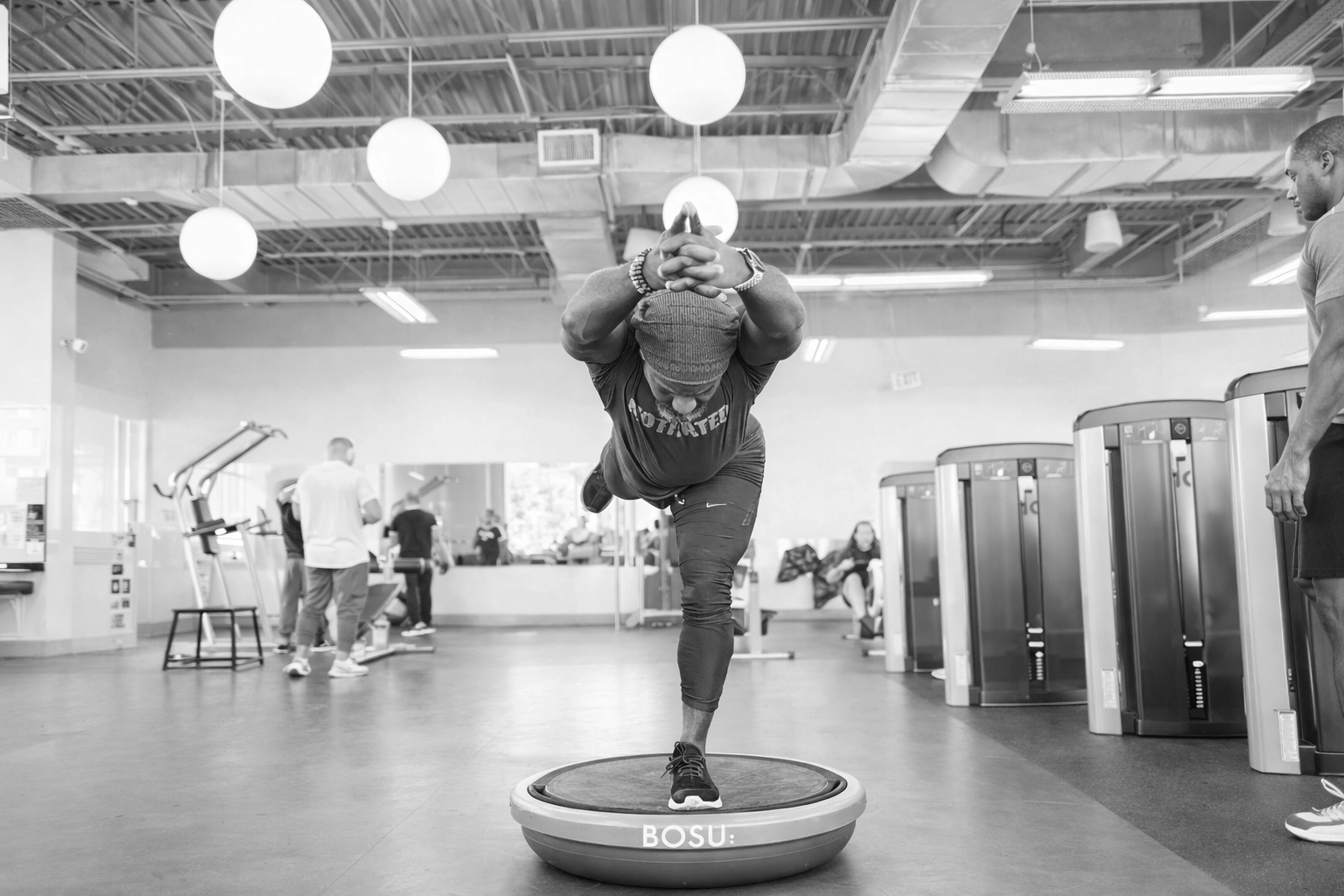
| Level 5: High-Level Integration | Balance and strength at the same time | Single-Leg Balance on a BOSU with a Lateral Raise |
By moving through these levels, you transition from "not falling" to "owning the movement." This is how you build a body that is truly durable. For active adults over 40, integrated strength work is where balance training becomes practical. The BOSU Lateral Raise is a high-level integration of balance and strength. It demands single-leg control, frontal-plane stability, and clean shoulder mechanics while the base of support stays unstable. It is efficient. It is demanding. It tells you quickly whether your system can handle load without leaking force.

Frequently Asked Questions (FAQ)
Why is balance harder as I get older?
It’s a combination of factors: reduced muscle mass (sarcopenia), slower nerve conduction, and a decline in the vestibular system (your inner ear). However, research shows balance is "plastic": meaning it can be improved at any age with consistent stimulus.
Can't I just lift heavy weights to get stable?
Lifting heavy builds strength, but if you only lift in machines or with bilateral movements (two feet on the ground), you might be masking instabilities. You need unilateral (one-sided) work to ensure your stabilizers are keeping pace with your prime movers.
How often should I train for balance?
The World Health Organization suggests balance and mobility work at least 3 days per week for aging adults. We recommend incorporating 5-10 minutes of stability work into your warm-up for every session.
Does footwear matter?
Yes. Training barefoot or in "minimalist" shoes occasionally can help strengthen the intrinsic muscles of the foot, which are your first line of defense for balance.
The Creative Fitness NYC Approach
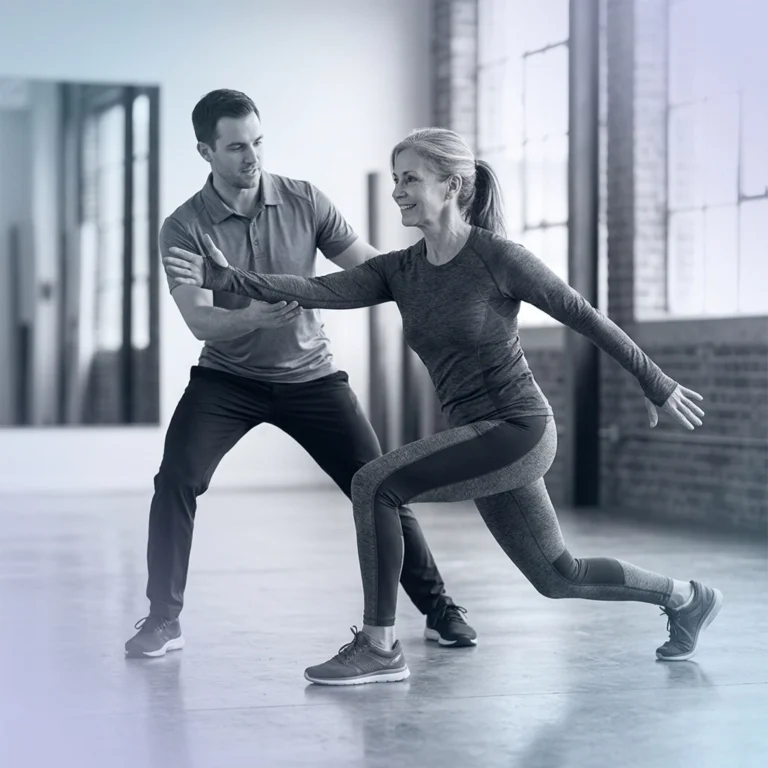
We don’t believe in "one-size-fits-all" fitness. For the adult over 40 in New York City, life is demanding. Your training should prepare you for those demands, not leave you too sore to function. Our trainers specialize in identifying your specific movement compensations and building a program that prioritizes your long-term durability, especially for clients over 40 who need training that builds capacity without unnecessary wear and tear.
Stability and balance aren't just "add-ons": they are the foundation of everything we do. Whether you are looking for online coaching or in-person sessions on location, our goal is to keep you moving well for the next 20+ years.
Ready to stop guessing and start measuring?
Don't wait for a tweak or a fall to realize your foundation is shaky. Take the first step toward a more durable version of yourself today.
Apply for a personalized movement assessment at www.creativefitnessnyc.com.